
A Copper Tlaco
2026-06-21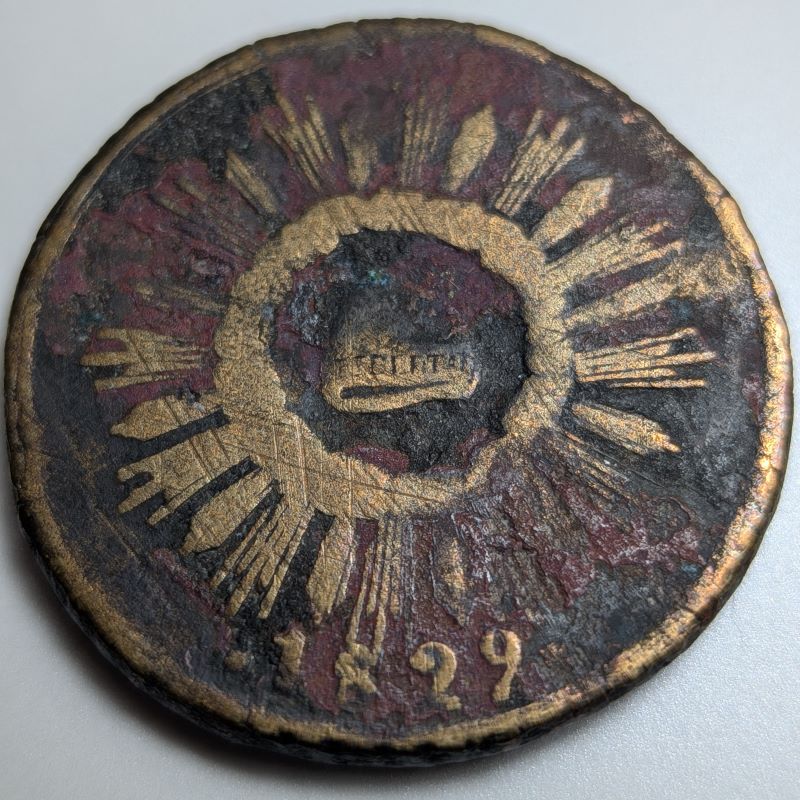
Helping my mom trace our family tree has taught me that this process is as much about the lives of individual people as it is about getting glimpses into their times. It is about finding vital records and trying to understand the historical context of the people they represent. This is why I got this little, battered copper coin.
This coin was issued by the Mexican State of Guanajuato in 1829, just five years after the founding of the Mexican Republic. Given the scratches and layers of corrosion, it has minimal numismatic value, but to me it is a memento of the times of the people in the tree my parents and I created. When this coin was struck, the miner strikes, the Indigenous rebellions, and the protracted but heady Revolution of Independence—which began in the town of Dolores, a short distance from Guanajuato—were all part of living memory.
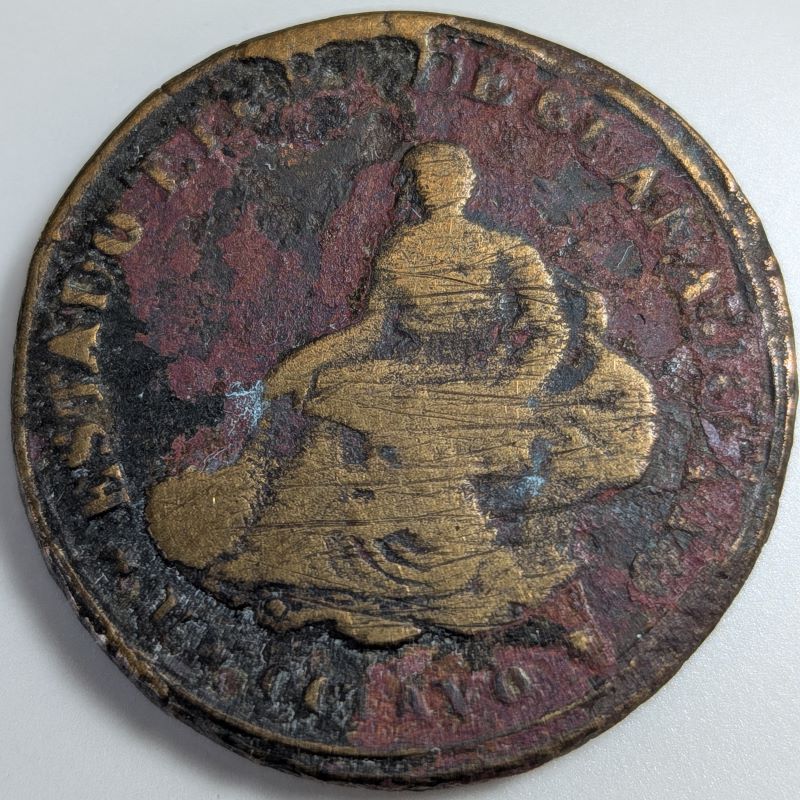
Like the layers of red and black copper oxides, the historical layers this coin evokes are complex, going far beyond Guanajuato. In the late 18th century, Guanajuato was one of the most productive intendencias in the Viceroyalty of New Spain. Tons of precious metals made their way to Acapulco and San Blas and were loaded on galleons sailing for the Philippines, and eventually China. The Kingdom of Spain used this pillaged wealth to establish presidios and missions up and down the Pacific Coast, robbing many Native peoples in California of their liberty and land.
By the time this coin was minted in 1829, San Francisco and the rest of Alta California were part of the infant Mexican Republic, and the captive Indigenous peoples of the Bay Area were free, but only on paper. The California missions would be secularized beginning in 1833 and shut down within a few years.
My family in the Indian pueblo-republics of San Francisco del Rincón and San Felipe Torresmochas would have used octavos, or tlacos1, like this after spending the day making tule baskets and huaraches for the silver miners. Guanajuato was a cosmopolitan city, dripping with riches, surrounded by dozens of other towns dedicated to supplying its basic needs through a hyper-racialized system.
A coin like this was the currency of the working class. A tlaco was an eighth of a silver real, enough to buy a simple meal2. Some beans, nopales and tortillas. Today, that same purchasing power would get you a simple rice and bean burrito in the Mission.
And perhaps this is the relevant moral for today’s San Francisco: how far, deep, and quickly a wealthy and globally influential city can fall when propped up by poverty and institutional inequality. ⸎
Tlaco or tlahco means “half” in Nahuatl/Mexican. It was the common colonial term for one-eighth (an octavo) of a real. It is also suspected to be the origin of the word “taco”, which makes sense to me given its relationship to working-class meals and how well it describes the dish itself. ↩︎
According to the construction manual Architectura mechanica conforme la practica de esta Ciudad de México, written sometime between 1794 and 1813, a real de comidas (a real for meals) was withheld weekly from wages paid to building trade laborers. That would be eight tlacos for 6-7 meals. ↩︎
— Your Correspondent accepts and appreciates Stripe Donations. —